Showing posts with label theory. Show all posts

Tuesday, June 07, 2011

Leaders...Born Of Nature or Practice?


Leaders, born or made? Scholar Richard Arvey found that among twins, leadership is 30 percent genetic/born and 70 percent learned/environmental. A pretty interesting thought to start with. We can also turn to the work of K. Anders Ericsson and his colleagues which may get to the heart of developing leadership in yourself and others…


“People believe that because expert performance is qualitatively different from normal performance the expert performer must be endowed with characteristics qualitatively different from those of normal adults. This view has discouraged scientists from systematically examining expert performers and accounting for their performance in terms of the laws and principles of general psychology. We agree that expert performance is qualitatively different from normal performance and even that expert performers have characteristics and abilities that are qualitatively different from or at least outside the range of those of normal adults. However, we deny that these differences are immutable, that is, due to innate talent. Only a few exceptions, most notably height, are genetically prescribed. Instead, we argue that the differences between expert performers and normal adults reflect a lifelong period of deliberate effort to improve performance in a specific domain” (Ericsson, Krampe, & Tesch-Romer, 1993, pp. 399-400).


One key seems to be intentionality and one problem is that many people are not deliberately “practicing” effective leadership. There is often no coach and it’s hard to get a real perspective on effectiveness, and even more difficult to get unfiltered perceptions of others. Feedback (personal, 360, coaching from supervisor or consultant) is one way to gauge progress. However, the interventions listed above are somewhat rare in organisational life. For instance, other than the annual performance review, what kind of ongoing coaching do you receive from your supervisor? Hopefully, a lot. Maybe not though.


Do some have a certain level of natural talent? Likely. Can others get better over time? Sure. Are you practicing the right stuff? Hopefully. 

Wednesday, February 16, 2011

Social Intelligence and Leadership


It has been observed that while some people may have strong intellectual abilities, they seem to struggle to master social skills which enable them to interact successfully with other people. This ability to 'get along' with others has been recognised amongst scholars as a form of competency or even a specific type of intelligence: social intelligence.

Social intelligence can be described as a combination of abilities: the first is a basic understanding of people (ie. a kind of strategic social awareness) and the second is the skills needed for interacting successfully with them. In other words, the ability to get along with other and to encourage them to cooperate with you.


Social intelligence can be thought of as encompassing five dimensions:

Presence – your external image or sense of self that is perceived by others, eg, confidence, self-respect or self-worth

Clarity – your ability to express yourself clearly, explain concepts clearly and using language effectively, while persuading with ideas

Awareness – your ability to understand social contexts that influence behaviour (ie. “read situations”) and to choose the behavioural strategies most likely to be successful.

Authenticity – the way of behaviour which gives a perception of honesty.

Empathy – your ability to create a sense of connection with others and to encourage them to cooperate with you, rather than work against you, as well as an appreciation for the emotions and experiences of others

The likes of Daniel Goleman argue that social intelligence alongside emotional intelligence are leadership competencies which are often overlooked, when considering how skilful a leader might be. So by embracing these dimensions of intelligence, and understanding the effect that leaders have on others, may influence how you approach future leadership interactions and as a consequence create overtly positive experiences for both parties. This is something that can be learned, although it can be hard to do so without appropriate self awareness or the help of others.

Wednesday, February 02, 2011

Spiritual Intelligence and Leadership


Danah Zohar and Ian Marshall, in their co-authored book Spiritual Intelligence - The Ultimate Intelligence [2001], suggests that empirical evidence is available for the existence of spiritual intelligence and for the existence of a "God spot" in the brain. This not about proving the existence of God but rather of a distinct type of intelligence within the human brain, alongside cognitive intelligence and emotional intelligence. 

Danah Zohar sees SQ as the intelligence that unifies experience, seeks meaning and drives us towards transcending and transforming our current reality. In other words, it is SQ that pushes us towards creativity. Therefore, according to Zohar, creativity is fundamentally a part of every human being. Much of her research incorporates reports gleaned from the reflections of acknowledged creators - artists, composers, sculptors, discoverers, scientists - who speak of the moment of creation as being akin to a spiritual experience.


Zohar distinguishes between the three types of intelligence thus:

IQ: cognitive intelligence is generally acknowledged by academia and education. It is essentially serial in nature, being logical and deductive; it is goal-oriented in nature, accurate, precise and reliable.

EQ: emotional intelligence, identified by Daniel Goleman [1996], and recognised as associative in nature. It makes links between emotions, between emotions and bodily feelings and enables us to recognise patterns like faces or smells, as well as to learn skills and to interact with others in social contexts. It is influenced by experience by virtue of being pattern-related. It becomes tacit learning, in that the experience, through practice, becomes part of the person.

SQ: according to Zohar spiritual intelligence is meaning-giving, contextualising and transformative. Understanding is essentially holistic and is linked to this unitive thinking. From here it is possible to rethink, to recontextualise and to create. Zohar sets out a number of dimensions:

1. Self-Awareness: you know who you really are and you know that you are connected to the whole universe.

2. Vision & Values Led: or Idealism. Children naturally want to serve, and so do we. Being vision and values led is definitive of our humanity.

3. The Capacity to Face and Use Adversity: owning our mistakes and adversity to learn

4. To be Holistic: seeing the connections between things. Being open to and interested in everything.

5. Diversity: thriving in and celebrating diversity. I look at you and see what is different in you and I say "Thank you for that!"

6. Field Independence: a term from psychology that means the courage not to bend to external forces but to remain independent.

7. The Tendency to Ask Why?: Questions are infinite. In Quantum Physics questions create reality.

8. The Ability to Re-Frame: putting things into a wider meaning.

9. Spontaneity: this is not about acting on a whim…it comes from the same Latin roots as response and responsibility. It is appropriately "responsive to" the world.


What does this add to our understanding of ourselves, our creativity and others? Just this: spiritual intelligence as the basis for all creativity - however great or small - means that the creative process is neither accidental nor trivial. Thus creativity is fundamental to the nature of human beings. It can be linked to our search for higher meaning. If high-level creativity is situated at the edge between order and chaos then perhaps we need a higher level of intelligence, that of spiritual intelligence, to help us navigate through the process.

Thus, far from being at the margins of our lives, creativity is central to who and what we are - and we need to be aware of this in our work, our play, our relationships and our development of self.


If all of this now seems a little too beyond the pale, it is worth remembering that Maslow's concept of self-actualisation suggests something very similar, though without the scientific framework offered by Zohar and Marshall. Jung's ideas of consciousness resonate with a similar idea to the concept of transformative thinking and transcendence.

The potential importance of this concept for the workplace lies in the emphasis that an organisation might place on values, principles and ethics.  At a leadership level, the implications are interesting. If a high IQ does not guarantee a good leader and high EQ has been correlated with success. What then if SQ is added to the melting pot. A practitioner may wish to consider taking a deeper approach to knowing themselves by accounting of their values and a sense of spirituality. However, the application of SQ in a leadership setting has yet to be fully tested and as such should is still very much open to debate and discussion.


Tuesday, January 25, 2011

The Art of Followership


Followership theory is an area that has seen minimal treatment in the academic literature and is an under-appreciated topic amongst leadership practitioners. Although it has received attention in the past (e.g. Chalef, 2003; Kelley, 1992), the study of followership is emerging once more as a critical notion for consideration with the advent of the information age and dramatic changes in organisational settings (Kellerman, 2008).


The idea that leadership is a relationship based on mutual exchange between leaders and followers is not new. Edwin Hollander (1958) suggested that leadership is a two-way influence and social exchange between leaders and followers. Building on these ideas, Robert Greenleaf (1977) went on to encapsulate the leader’s obligation to any followership with the idea that leaders should strive to be ‘servants’. In return, followers ideally provide leaders with a wide variety of positives including focus and self-direction, gratitude and loyalty, commitment and effort, as well as cooperation and sacrifice. 


Reflecting this reciprocal approach, Messick (2005) describes leadership as a mutually beneficial predicated exchange in which leaders ideally strive to provide their followers with an equally varied subset of paybacks, including vision and direction, protection and security, achievement and effectiveness, as well as inclusion and belongingness. In similar fashion, Hollander (2008) also promotes a process of active followership, emphasising follower needs and expectations, with the guiding principle of "doing things with people, not to people”. Of course, it is rare that all of these factors are either met or even required by both leaders and followers. Nevertheless, some particular subset of these ‘rewards’ would usually be apparent in any leader-follower relationship, with the exact combination varying according to some combination of both participant characteristics and the environmental/goal context


As long as there have been leaders, there have been followers, and leaders cannot accomplish what they do without followers (Kelley, 1992). Newell (2002) suggested that a growing trend in leadership is to inspire followership, and to this end, coaching and mentoring outdoor practitioners to transform participants into good followers should be considered an essential skill in today’s environment. Outdoor leaders must actively contribute to the forming of good leader-follower relationships (Vince, 2002) if they are to benefit from the leader-member exchange and promote the sharing of group goals personal beliefs and values consistent with the axioms that exist in the outdoors. Finally, Banutu-Gomez’s (2004) contention that leaders must teach their followers to be good followers requires the development of concepts consistent with leader-follower exchanges that place leadership in the hands of the followers.


Friday, January 15, 2010

Cycle for Reflection

Graham Gibbs’ (1988) model of reflection provides a structured way of carrying out reflective practice for those who may require guidance on techniques. This model originated from the teaching profession but can be easily transferred for use within of coaching and leadership settings. Gibbs' model incorporates all the core skills of reflection. Arguably it is focused on 'reflection-on-action', but with practice it could be used to focus on reflection in and before action.


Stage 1: Description of the event

Describe in detail the event you are reflecting on.

Include e.g. where were you; who else was there; why were you there; what were you doing; what were other people doing; what was the context of the event; what happened; what was your part in this; what parts did the other people play; what was the result.

Stage 2: Feelings and Thoughts (Self awareness)


At this stage, try to recall and explore those things that were going on inside your head. Include:

How you were feeling when the event started?
What you were thinking about at the time?
How did it make you feel?
How did other people make you feel?
How did you feel about the outcome of the event?
What do you think about it now?

Stage 3: Evaluation


Try to evaluate or make a judgement about what has happened. Consider what was good about the experience and what was bad about the experience or what did or didn’t go so well

Stage 4: Analysis

Break the event down into its component parts so they can be explored separately. You may need to ask more detailed questions about the answers to the last stage. Include:

What went well?
What did you do well?
What did others do well?
What went wrong or did not turn out how it should have done?
In what way did you or others contribute to this?

Stage 5: Conclusion (Synthesis)

This differs from the evaluation stage in that now you have explored the issue from different angles and have a lot of information to base your judgement. It is here that you are likely to develop insight into you own and other people’s behaviour in terms of how they contributed to the outcome of the event. Remember the purpose of reflection is to learn from an experience. Without detailed analysis and honest exploration that occurs during all the previous stages, it is unlikely that all aspects of the event will be taken into account and therefore valuable opportunities for learning can be missed. During this stage you should ask yourself what you could have done differently.

Stage 6: Action Plan 

During this stage you should think yourself forward into encountering the event again and to plan what you would do – would you act differently or would you be likely to do the same?

Here the cycle is tentatively completed and suggests that should the event occur again it will be the focus of another reflective cycle.


Thursday, January 14, 2010

Frameworks for Reflection


John Dewey identified three characteristics or attitudes of people who are reflective  - open-mindedness, responsibility and wholeheartedness. At a basic level models of reflection exist to provide guidance to help us look back over events that have happened and to turn them into learning experiences for the future. In essence models of reflection help us to:

Look at an event - Understand it - Learn from it

There are a variety of strategies to implement reflective practice. Donald Schon refers to ‘reflection-in-action’ as analysis in the present tense (during the performance of a task) and 'reflection-on-action' as  retrospective analysis (after the performance of a task). Killion and Todnem (1991) categorize reflection in three directions:

Firstly, reflection-on-action requires looking back on what one has accomplished and reviewing the actions, thoughts, and product.

Secondly, reflection-in-action. In this activity, the individual is responsible for reflecting while in the act of carrying out the task. If, for example, the student is writing a story and has left out the setting, reflection-in-action could guide the correction of a major component of the story writing.

The final reflective form centres on reflection-for-action. This reflection form expects the participant to review what has been accomplished and identify constructive guidelines to follow to succeed in the given task in the future.


Reflection for action - Before
Forethought
Strategic Planning
Influential processes which precede efforts to act and set the stage for action
Goal setting increases self-efficacy and intrinsic interest
Self-motivation beliefs increase:
• Commitment
• Self-efficacy
• Outcome expectations
• Intrinsic interest/value
• Goal Orientation

Reflection in action - During
Performance or Volitional Control
Processes that occur action and affect attention and action
Self-observation, self-recording, self-experimentation allows learners to vary aspects of their performance
Self-control processes help learners to focus on tasks and optimize efforts including:
• Self-instruction
• Imagery
• Attention focusing
• Task Strategies

Reflection on action - After
Self-reflection
Self-judgment- Self-evaluation & Casual attribution
Self-reaction - Self-satisfaction/affect &Adaptive-defensive response
Processes which occur after performance efforts and influence a person’s response to that experience
Planning and implementing a strategy provides an evaluation metric for learners to attribute successes or failures to, rather than low ability


Tuesday, January 12, 2010

Discussing Reflective Practice


Reflection is an activity by which experience is recaptured, thought about and evaluated.. reflection as a learning activity is said to be intentional and purposeful with the aim of changing behaviour.” (Boud et. al, 1985)

Donald Schon, an influential writer on reflection, described reflection in two main ways: reflection in action and reflection on action. Reflection on action is looking back after the event whilst reflection in action is happening during the event. To complicate matters there are different interpretations of reflection on action. Let’s now explore these terms.

Reflection in action means

To think about what one is doing whilst one is doing it; it is typically stimulated by surprise, by something which puzzled the practitioner concerned.” (Greenwood, 1993)

Reflection in action allows the practitioner to redesign what he/ she is doing whilst he/she is doing it. This is commonly associated with experienced practitioners. However, it is much neglected.

Reflection on action is defined as:

The retrospective contemplation of practice undertaken in order to uncover the knowledge used in practical situations, by analysing and interpreting the information recalled.” (Fitzgerald, 1994: 67)

We can see here that reflection on action involves turning information into knowledge, by conducting a cognitive post mortem.

Alternatively Boyd & Fales suggest reflection on action is:

The process of creating and clarifying the meanings of experiences in terms of self in relation to both self and world. The outcome of this process is changed conceptual perspectives” (Boyd & Fales, 1983: 101)

We see here that Boyd and Fales focus more on self development. Here refection does not only add to our knowledge but challenges the concepts and theories we hold. Furthermore as a result we don’t see more, we see differently.

Atkins and Murphy (1994) take this idea one step further and suggest that for reflection to make a real difference to practice we follow this with a commitment to action as a result.

The problems with these views of reflection on action are that they do not take account of the importance of reflection before action (Killion and Todnem (1991).


Tuesday, January 05, 2010

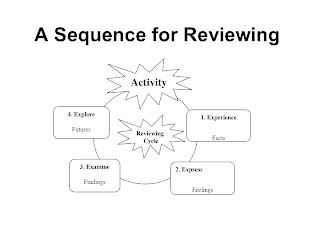
A Sequence For Reviewing


"Through reviewing you show that you care about what participants experience, that you value what they have to say, and that you are interested in the progress of each individual..." (Greenaway, 1996)

Authors on reviewing processes have expressed that following a particular reviewing sequence can lead to a greater degree of learning transfer. Here is a structured sequence offered by Dr Roger Greenaway

1. Experience

The first stage is to establish ‘play back’, or ‘relive’ what happened. This stage can serve as a useful reminder of significant incidents. This stage can help set the agenda for later stages, but the main focus of this first stage is on what happened.

Questions that can be asked include:
1) How did the activity go?
2) What did your group achieve in the activity?
3) Was there evidence of any barriers during the activity?
4) What were they based on? (language, gender, age, geography)
5) How were the barriers identified?
6) Did the group take steps to overcome these? How?
7) Did the activity draw out any other issues? How?
8) Was the activity of benefit? How? Why ? Why not?
2. Express

The second stage is a vital one, but tends to be the stage most at risk if review time is limited. This stage recognises that activities (especially new or challenging ones) stimulate the senses and arouse emotions. This stage focuses on the quality of the experience: “What was it like?”, “How did it feel?”


3. Examine

The third stage is more analytical and rational. ‘All talk’ reviews tend to arrive too soon at this stage, especially if reviewers are too impatient to draw out the learning from the activity. If the experience has been a ‘whole person’ experience, it is important to use review methods, which match the fullness of the experience.

4. Explore

The forth stage is the most practical stage. It involves preparing to try out something that has been prompted by earlier stages of the sequence. This stage would usually involve setting targets. Above all, it is important to keep the sense of curiosity and exploration alive.

Lean more about reviewing from Dr Roger Greenaway

Wednesday, December 30, 2009

10 Benefits of Reviewing


Here are 10 benefits that make reviewing a 'must do' after a learning experience
1. You are more in touch with learners' perspectives
2. You are developing their communication skills
3. You are developing participants' skills (yours and theirs)
4. You are adding value to what is already happening
5. You are making benefits more tangible
6. You are generating evidence for evaluation
7. You become more alert and responsive
8. You help participants clarify and achieve their objectives
9. You make transfer of learning more likely
10. Participants enjoy it
Here are 10 reasons for why we should engage in reviewing
1. Adding value to the experience
2. Getting unstuck
3. Achieving objectives
4. Opening new perspectives
5. Developing observation and awareness
6. Encouraging self-expression
7. Using success
8. Providing support
9. Empowering people
10. Caring about the participants
Here are 10 benefits when engaged in active reviewing processes
1. It is more likely to engage all learning style preferences.
2. It creates better integration between talk and action.
3. It provides more ways to communicate, learn and develop.
4. It produces more dynamic, enriched and focused reviewing.
5. It gives better access to intuitive and tacit knowledge.
6. It pays more attention to the experience of reviewing.
7. It generates more effective learning from experience.
8. It allows more realistic testing of future plans.
9. It increases the range of strategies for effective transfer.
10. Active reviewing is even more enjoyable!
Lean more about reviewing from Dr Roger Greenaway