Showing posts with label coaching. Show all posts

Wednesday, November 26, 2014

Meet The SGS USA Team


Meet the Storm Gathering USA team that will be coaching in March. 


We look forward to seeing you in Trinidad, CA.

============================================================
Copyright © 2014 Greenland or Bust, All rights reserved.

Helen Wilson and Mark Tozer • (707) 834-5501

info@greenlandorbust.org


Wednesday, December 08, 2010

BCU Assessment Weekend


Well folks, this is it. No more BCU Level 3 Coach (Sea) assessments for me, and soon no more assessments in this vein after the 31st December. It has been a tremendous honour to have facilitated, and participated in, the assessment of over 100 coaches, from both the UK and overseas.


I have been very fortunate to have worked alongside some very fine people too, who have been fair minded and thorough in their assessment of these candidates. And whilst not everyone has been successful on their first attempt, those that have come back have done so because of the extended support offered to them. BCU coaches are part of a larger network, being a Level 3 coach is more than just a badge of honour, it is both a way of life and a philosophy.


And so it was that Micky, Richard, Chris, Danny and David presented themseleves for assessment on the 6th December in Trearddur Bay having braved the awful weather and driving conditions. Along with this, Gary, David and Mike were present to complete their BCU 4* Sea assessment. Again, it was great to have another Canadian candidate, this time Chris Lockyer from Nova Scotia who had successfully gone through the APL process and therefore able to attend.


Nick Cunliffe and Aled Williams made up the rest of the assessment team along with myself. We were also graced with the company of Ulrika Larsson from Sweden who was observing the assessment process.


Aled took the 4* candidates out to South Stack and back, to assess personal skills and some leadership dimensions including navigation. Nick and I divided up the Level 3 candidates to examine their skills as educators and engage them is discussion about the coaching process, as well as looking at their ability to present useful information to the students (made up of the faithful and keen from Snowdonia Canoe Club).


Even though the conditions where somewhat chilly and at times damp due to the rain, the candidates and the students remained in good spirits throughout. As ever, Nick and I observed a range of approaches to passing on the knowledge and skills of sea kayaking, which in many ways reflected the nature and experiences of those doing the coaching.


Sunday saw the assessment team and candidates gather at Borthwen. Again, Rhoscolyn is an ideal venue for such assessments as it offers a full range of conditions and crossings that will test any leader, and catch the unprepared off guard. And so it was, in the company of Aled and Ulrika, we set out for the Beacon and then Rhoscolyn Head whilst Nick took on the 4* team.


As to be expected, we were not the only assessment taking place on the water that weekend, having bumped into Trys Burke (ne Morris) who is a Community Coach Development Officer for Canoe Wales Trys was also running a 4* assessment with a number of local club paddlers. I think it actually helped our candidates get some perspective, in that they were not the only ones with a grim look of terror in their eyes. Trys is actually a big softy but she knows how to make a candidate work for their pass. 


Those that have followed past reports will know this day is about effective leadership, shaping a good course and dealing with issues and problems. Each candidate took it in turns to lead, guide and manage the others. With Aled on board, creative yet realistic scenarios were also on the cards, which everyone dealt with succesfully, and in one case, with good humour associated with paddle float disasters.


Despite the efforts of some candidates to snatch defeat from the jaws of victory, on this occasion everyone managed to redeem themselves having been scrutinised by three assessors. Its is always a welcome and pleasant end to such assessments, but this one in particular, to say well done to one and all on their hard efforts and successes :o)


I'd like to take this as an opportunity to express my heartfelt thanks to the likes of Nick CunliffeAled WilliamsDave EvansPete JonesNigel DennisDave BrownMike DevlinAdam Harmer and Trys Burke (ne Morris), as well as many others besides, who have had a tremendous impact on me as a both a trainer and assessor.


Thanks also go out to Kokatat, Tiderace and Mitchell Blades for whom I am an ambassador and whose equipment and clothing has kept me comfortable, dry and happy on the water throughout the year. Pete Baars of Summit to Sea on Anglesey also earns a mention in dispatches for his help with supplying candidates with equipment and providing quality retail services.


Get in touch if you are interested in completing a BCU assessment course or just wish to look at your skills development in a boat.


More pictures of this course available here

Wednesday, November 17, 2010

BCU Assessment Weekend


Last weekend was my penultimate BCU Level 3 Coach (Sea) assessment as a course provider in the current scheme. As previously mentioned, after the December 2010, the award as we know it will no longer exist and will be replaced in part by the Moderate Water Endorsement.


With Dave Evans on hand as my second assessor, 6 candidates joined us in Trearddur Bay on Saturday morning along with a group of trusty volunteers from Snowdonia Canoe Club who would be acting as students for the team. Simon, Debbie, James, Meaghan, Peter and Joy had travelled from near and far to present themselves as prepared and proficient coaches, brimming with energy and enthusiasm ready to teach and lead. In the case of Meaghan, she had come a very long way to sit this assessment...Vancouver to be precise.


After dividing up the candidates amongst the two us, Dave and I set about watching the coaches in action as they employed a number of skills and strategies to improve and encourage their students. It is always a fascinating study of human behaviour as one observes each coach goes through well rehearsed routines and see them deliver effective learning episodes. The reason I say fascinating is because no matter how supportive and open an assessment team try to be, individuals can still put themselves under tremendous personal pressure even when they are doing a good job.


On this occasion the coaches where confined somewhat to the inner sanctum of Trearddur Bay as a strong swell was still present in Penrhos Bay. However, this didn't prevent them for offering up some exemplary on the water sessions, along with interesting and interactive beach based presentations on subjects such as tides, equipment and shore ecology.


Sunday saw us relocate for to the north coast, launching from Bull Bay and heading on a westerly course towards Porth Wen Brickworks. As each candidate took turns to lead the group they faced a number of issues, as one might expect on assessment. It is often easy to exploit an opportunity and turn it into an incident, especially when a coach turns their back on a group member. For instance, as someone explores a cave with heavy swell present, it is almost guaranteed they will take a swim. However, it is important not to create too many artificial situations and sometimes it is easier to see people perform towing duties and deep water rescues by simply asking them too.


One of the great pleasures of working with Dave Evans is that he is a consummate professional and highly knowledgeable on matters of seamanship. He also has a knack of testing and probing what candidates know in novel yet constructive ways. So it was while the candidates showed us the equipment they were carrying and justifying the reasons, Dave was hatching one of his group quizzes. As expected, the candidates took to the task and even enjoyed the humour of the situation as they both answered and asked questions on matter relating to the sea.


After the pleasant break at Porth Wen, the return journey continued in the same vein as before. And perhaps because Dave and I are traditionalists or maybe because this was the penultimate course, the assessment finished with an 'all-in' rescue with a cry of 'thank heaven for drysuits' from the swimming coaches. Once all were safely ashore, Dave and I took time to reflect and deliberate on the performance of each candidate. On this occasion it is pleasing to report we were both in full agreement that all the candidates should move forward to being Level 3 Sea coach. Well done one and all :o)


Get in touch if you are interested in completing a similar assessment course or just wish to look at your skills development in a boat.

More pictures of this course available here

Wednesday, September 15, 2010

BCU Assessment Weekend


The weekend saw a number of candidates put themselves up for assessment - Simon, Rich and Chala had decided to complete their BCU Level 3 Coach (Sea) award, whilst Alex and Marc where taking the 4* Leadership (Sea) award. 


To achieve the current BCU Level 3 Coach qualification (not to be mistaken for the new BCU / UKCC Level 3), a candidate is assessed on their ability to delivery more sophisticated and perhaps more individualised coaching to a group within a specific environment, in this case the sea. There are elements of leadership, group management and risk awareness on test also. If successful, a BCU Level 3 Coach (Sea) can work in moderate water conditions on the open ocean (including launching and landing in surf) and can assess 1, 2 and 3 star awards. For reference, this award will no longer be assessed after December 2010.


In the case of the 4* award, whilst a key component is the ability to demonstrate paddle skills in a linked and fluid manner, sound leadership is variety of situations is the foremost issue under examination. The 4* is an ideal award for those paddlers who are leading club trips, and is a prerequisite to completing the BCU Moderate Water Endorsement.

The first day saw Rich, Simon and Chala work with a group of students from a wide range of paddling backgrounds who had volunteered their time for the day. All three were given the opportunity to demonstrate their coaching abilities using Trearddur Bay as a classroom, which has numerous sheltered coves along with islands and inlets that allow for progressive activities and application of skills. Also, each of the candidates completed a beach based presentation, varying from knots for sea kayakers to tidal planning, that made for interactive sessions of a different kind for the students.


Rich and Marc spent the day in the company of Nick Cunliffe, also launching from Trearddur Bay but setting out on a journey that would assess their primary paddling and leaderships skills. This team had an enjoyable time shaping a course out to Rhoscolyn Head and back with a good slight to moderate sea state and ideal wind conditions.


The second day saw all the candidates gather at Cemaes Bay with the explicit intention of looking at their ability to assess risks, uphold their duty of care and to manage groups on the water as leaders. This day also examines a candidate's ability to deal with incidents, both minor and significant, that might arise when leading a trip. There a further opportunity to ensure personal paddling performance is of a high standard, especially checking manoeuvring skills and close quarter techniques which enable a leader to respond more rapidly to issues as well as assessing a candidate capacity to self rescue and eskimo roll.


Both assessments need to be a thorough and fair exploration of a candidate's skills, knowledge and understanding of the role of a coach, and that of a leader. Looking at both practical and theoretical dimensions that are inherent within the awards. On this occasion, I am pleased to say that everyone was successful and went away with big smiles.


Get in touch if you are interested in completing any of these awards or just wish to look at your skills development in a boat.


More pictures of the weekend can be found here

Wednesday, July 28, 2010

Association of Paddlers/ Coaches

A new organisation in the making......


The Association of Paddlers/ Coaches is a collaboration of Level 5 coaches across disciplines that provide the highest level of coaching and the training and assessment of NGB awards. These coaches are also active paddlers having their own adventures in their spare time, be it in the UK, Europe or on expedition. Membership is open to any L5 coach be it a freelancer or in full time employment, who is an active coach working at a range of levels and who is an active paddler in their free time. 

The L5 coach is the highest coaching award in the UK and at the moment there is no independent organisation to promote their services. The aim of the logo and the website is to provide a simple way of identifying the highest levels of coaching from active paddlers passionate about their sport. Our members are chosen by their peers and the criteria ensures that not only are they L5 coaches, but they are active in their chosen discipline.They provide evidence of this which has to be updated every 2 years to retain membership. This ensures you get the highest quality coaching from active passionate paddlers.


It is being formed by Olly Sanders of Rock and Sea Adventures and Rock and Sea Productions.

Wednesday, June 30, 2010

BCU Level 3 Coach (Sea) Assessment


The BCU Level 3 Coach award aims to provide a minimum qualification for those wishing to be in charge of paddlesport activities for a club or school, supervising groups on ‘moderate’ water. The training and assessment courses are discipline specific – in this case for sea kayaking which includes coastal journeys on tidal waters. 

The purpose of the assessment course is to ensure that all candidates for the award have a sound understanding of both the environment in which they operate and paddlesports generally. Our aim is to create an assessment atmosphere whereby candidates can show their best in terms of kayaking abilities, knowledge and teaching skills.

Dates:

11 & 12 September - 4 places still available

9 & 10 October - 5 places still available

13 & 14 November - 4 places available

4 & 5 December - final course

Location: Anglesey, North Wales

Cost: £150 (includes £17.50 WCA admin fee) non-residential

Minimum: 3 candidates

Requirements: C1 or exemption letter, first aid, 30 coaching hours

Discount: Available to WCA club coaches and full time students

Please e-mail me if you are interested in attending


Wednesday, February 24, 2010

PyB Paddlesports Expedition Symposium


February 2010 saw nearly a hundred delegates come together for the 3rd Paddlesport Expedition Symposium at Plas y Brenin in North Wales. It was organized by Pete Catterall, Head of Paddlesports, and supported by many great guest speakers and coaches including the likes of Justine Curgenven and Ray Goodwin, one of the UK’s few triple Level 5 coaches. The event provided a memorable opportunity for participants from all over the UK, Europe and the USA to come together to share their experiences and skills. 


The two days was jam packed with fascinating talks, workshops and discussions covering everything from canoe poling, gear selection, tarpology with Jules Burnard and bushcraft to bear proofing your kit, recording the trip and exploring leadership / group dynamics on expedition with yours truly. It was all run with the relaxed professionalism always associated with Plas Y Brenin. However that didn’t stop a few symposium staff from getting up to mischief on the Sunday morning by participating in some ‘snowyaking’ after a fresh dump of powder!


Saturday was concluded with a highly exclusive preview of Justine’s forthcoming DVD release of ‘This is Canoeing’, which was very well received. This was followed by Peter Catterall and his team talking about their ‘Below and Beyond Machu Pichu ‘09’ trip which was a kayaking expedition to complete a first decent of the Rio Concebidayoc in the Quillabamba region of Peru. 

Overall it was an engaging and enjoyable experience as to be there as a guest speaker and occasional participant when there was time to sneak into other workshops. Praise should go to Pete and all the team for delivering a great symposium that was all things to all participants with plenty of time to network and gather information.


As always, ...and a big thank you to Kokatat who continue to provide me with quality paddling apparel to wear on and off the water

Monday, January 11, 2010

Discovering Reflective Practice


It seems to me that the notion of "reflective practice" offers a highly challenging paradigm for learning and a means of enhancing the coaching process. Central to any learning episode needs to be a specific practice event, experienced uniquely and differentially, often by a small number of people. The outcome of which is to likely derive a number of more abstract generalisations that can be applied to future situations.

The acquisition of knowledge through the medium of reflection is not a new concept; Plato argued that to know something required recollection and is therefore a reflective and introspective process. Some consider it a transformation process whereby experience and theory become knowledge. Others take the view that whilst reflection enhances our knowledge it may also confront our ideas and underpinning theories. Reflecting on a situation allows us to develop and view things differently. Bill Taylor, BCU Level 5 Inland Coach, regards reflection to be a potent process in gaining a deeper understanding of the reasoning behind why things do or don’t work. Leberman and Martin state that “reflection is fundamentally important, provides a major contribution to personal growth and therefore affects the transfer of learning” (2004: 174).

Cultivating the capacity to reflect in action (while doing something) and on action (after you have done it) is becoming an important feature of training programmes in many disciplines. Another aspect that is also emerging is recognising how the assistance a mentor can be beneficial in gaining the most from an experience. Indeed, it can be argued that 'real' reflective practice needs another person as mentor or supervisor, who can ask appropriate questions to ensure that the reflection goes somewhere, and does not get bogged down in self-justification, self-indulgence or even self-pity!

Reflective learners are likely to be: more self-aware and self-critical; honest about themselves, and open to criticism and feedback; objective in weighing up evidence; open to, and prepared to try, different approaches; curious to discover other approaches, motivated to improve, and more able to carry through independent learning.


Tuesday, January 05, 2010

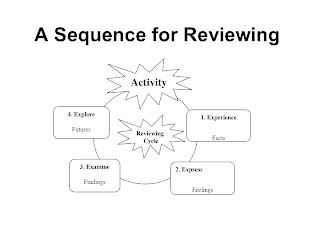
A Sequence For Reviewing


"Through reviewing you show that you care about what participants experience, that you value what they have to say, and that you are interested in the progress of each individual..." (Greenaway, 1996)

Authors on reviewing processes have expressed that following a particular reviewing sequence can lead to a greater degree of learning transfer. Here is a structured sequence offered by Dr Roger Greenaway

1. Experience

The first stage is to establish ‘play back’, or ‘relive’ what happened. This stage can serve as a useful reminder of significant incidents. This stage can help set the agenda for later stages, but the main focus of this first stage is on what happened.

Questions that can be asked include:
1) How did the activity go?
2) What did your group achieve in the activity?
3) Was there evidence of any barriers during the activity?
4) What were they based on? (language, gender, age, geography)
5) How were the barriers identified?
6) Did the group take steps to overcome these? How?
7) Did the activity draw out any other issues? How?
8) Was the activity of benefit? How? Why ? Why not?
2. Express

The second stage is a vital one, but tends to be the stage most at risk if review time is limited. This stage recognises that activities (especially new or challenging ones) stimulate the senses and arouse emotions. This stage focuses on the quality of the experience: “What was it like?”, “How did it feel?”


3. Examine

The third stage is more analytical and rational. ‘All talk’ reviews tend to arrive too soon at this stage, especially if reviewers are too impatient to draw out the learning from the activity. If the experience has been a ‘whole person’ experience, it is important to use review methods, which match the fullness of the experience.

4. Explore

The forth stage is the most practical stage. It involves preparing to try out something that has been prompted by earlier stages of the sequence. This stage would usually involve setting targets. Above all, it is important to keep the sense of curiosity and exploration alive.

Lean more about reviewing from Dr Roger Greenaway

Wednesday, December 30, 2009

10 Benefits of Reviewing


Here are 10 benefits that make reviewing a 'must do' after a learning experience
1. You are more in touch with learners' perspectives
2. You are developing their communication skills
3. You are developing participants' skills (yours and theirs)
4. You are adding value to what is already happening
5. You are making benefits more tangible
6. You are generating evidence for evaluation
7. You become more alert and responsive
8. You help participants clarify and achieve their objectives
9. You make transfer of learning more likely
10. Participants enjoy it
Here are 10 reasons for why we should engage in reviewing
1. Adding value to the experience
2. Getting unstuck
3. Achieving objectives
4. Opening new perspectives
5. Developing observation and awareness
6. Encouraging self-expression
7. Using success
8. Providing support
9. Empowering people
10. Caring about the participants
Here are 10 benefits when engaged in active reviewing processes
1. It is more likely to engage all learning style preferences.
2. It creates better integration between talk and action.
3. It provides more ways to communicate, learn and develop.
4. It produces more dynamic, enriched and focused reviewing.
5. It gives better access to intuitive and tacit knowledge.
6. It pays more attention to the experience of reviewing.
7. It generates more effective learning from experience.
8. It allows more realistic testing of future plans.
9. It increases the range of strategies for effective transfer.
10. Active reviewing is even more enjoyable!
Lean more about reviewing from Dr Roger Greenaway